Every service business owner knows the frustration: a client booked at 2pm, the chair is ready, the slot is blocked – and nobody walks in. You have already turned away another client who wanted that time. The revenue is gone, and the costs of keeping the salon open for that hour are not.
Most owners absorb the loss and move on. But no-shows are not a random annoyance. They are a measurable, recurring cost – and once you put a number on it, you can decide how aggressively to address it.
We covered no-shows as one of five key salon challenges in a previous article. This one goes deeper: what no-shows actually cost you, how often they happen, and what you can do to bring the number down.
What a No-Show Actually Costs You
The obvious cost is the price of the missed service. A client who does not show up for a R400 colour appointment costs you R400 in revenue.
But that is not the full picture. During that empty hour, you were still paying for:
- Rent and utilities for the space
- Staff wages for the stylist who had nothing to do
- Products or setup if preparation happened before the client was expected
- The opportunity cost of the client you turned away because the slot was “booked”
That last one is the hardest to see and often the most expensive. According to the Fresha cancellations study, 46% of salon owners say cancellations force them to turn away other clients who could have filled those slots.
Here is a way to estimate your own annual cost. The numbers below are examples – replace them with your own:
| Your number | Example |
|---|---|
| Average appointments per week | 30 |
| Average service price | R400 |
| Your no-show rate | 10% |
| No-shows per week | 3 |
| Lost revenue per week | R1,200 |
| Lost revenue per year (x 50 weeks) | R60,000 |
Even at a modest 10% rate, a salon with 30 weekly appointments at R400 average loses R60,000 a year. At 15%, that is R90,000. At 20%, R120,000.
These are not theoretical industry averages – they are straightforward arithmetic you can run with your own booking data.
How Often It Happens
No-shows are not rare events. The Fresha survey, which covered more than 200 UK beauty and wellness businesses, found that:
- 30% of salons deal with cancellations or no-shows one to two times per week
- 14% face them three or more times per week
- Only 8% reported never experiencing them
The timing makes it worse. Sixty-two percent of clients who cancel do so with less than 24 hours’ notice, and 20% cancel with under 12 hours. At that point, filling the slot with another paying client is almost impossible – especially if you are a small operation without a long waitlist.
This is not a problem you can solve by hoping clients will be more considerate. It happens too often and too late for that.
The Costs You Do Not See
Revenue loss gets the most attention, but there are costs that do not show up on any spreadsheet.
Financial strain. The Fresha survey found that 56% of beauty and wellness businesses say cancellations cause significant income loss, with 29% losing between 5% and 10% of their monthly revenue and a further 15% losing between 11% and 20%.
Longer working hours. When revenue drops, many owners compensate by working more. Fifty-five percent of salon owners in the survey say cancellations and the resulting admin burden force them to work longer hours.
Mental health. Forty-four percent of salon owners say no-shows take a real toll on their mental health. For 26%, the problem is serious enough that they question whether to stay in the industry.
These effects compound. A bad no-show week does not just cost money – it costs energy, motivation, and the feeling that you are building something stable. That matters, even if it does not have a line item.
Six Ways to Reduce No-Shows
There is no single fix. The right approach depends on your business size, your client base, and how severe the problem is. Here are six strategies, starting with the simplest.
1. Track your rate
You cannot fix what you do not measure. Before trying anything else, find out your actual no-show rate as a percentage. Is it 5%? 15%? 25%?
Scheduling software that distinguishes between completed, cancelled, and no-show bookings does this automatically. In Minuvox, every booking has a status, and the dashboard shows your no-show rate as a live KPI. You can view it by day, week, month, or year to spot trends.
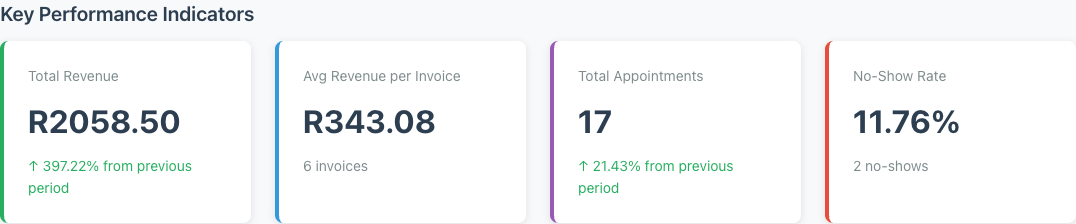
Once you know the number, you can calculate what it costs you using the table above – and decide how much effort is worth putting into reducing it.
2. Confirm appointments manually
A phone call or text message the day before the appointment is one of the simplest ways to catch cancellations early enough to fill the slot. It takes time, especially if you have a full book, but it is effective for high-value appointments.
This works best as a targeted approach: confirm the expensive or new-client appointments rather than every single one.
3. Set a clear cancellation policy
If clients know there are consequences for no-showing, some will think twice. A cancellation policy does not need to be punitive – but it needs to exist and be communicated at booking time.
Common approaches:
- Require 24 or 48 hours’ notice for free cancellation
- Charge a flat fee (e.g. R100) or percentage (e.g. 50% of the service price) for no-shows
- After two or three no-shows, require prepayment for future bookings
The key is consistency. A policy that is enforced sometimes and waived other times teaches clients that the rules are flexible.
4. Collect deposits at booking
A deposit shifts some of the financial risk from you to the client. When a client has money on the line, they are more likely to show up or cancel with proper notice.
How much to charge varies. Some businesses collect a flat amount (R50-R200); others charge a percentage of the service price. The deposit is typically applied to the final bill if the client shows up.
5. Keep a waitlist
If you have more demand than slots, a waitlist lets you fill gaps quickly when someone cancels. Even an informal one – a list of clients who said “call me if anything opens up” – is better than nothing.
This works best for salons in busy areas or during peak periods. If you rarely turn away clients, a waitlist will not help much.
6. Automated appointment reminders
Automated SMS or email reminders are the most commonly cited tool for reducing no-shows. The logic is straightforward: many no-shows happen because clients forgot, and a reminder the day before gives them a chance to cancel in time for you to rebook.
Many scheduling platforms offer this as a built-in feature. Minuvox does not currently send automated reminders. If reducing no-shows through automated reminders is a priority for your business, check whether the scheduling tool you use – or are evaluating – supports them.
Reminders are not a magic fix. They help with forgetful clients but do not address serial no-showers, scheduling conflicts, or clients who simply do not respect your time. They work best as one part of a broader strategy that includes tracking, policies, and deposits.
Start With the Number
Before you invest in deposits, policy changes, or new software, do one thing: find out your actual no-show rate and calculate what it costs you per month.
That number tells you everything:
- If it is low (under 5%), your current approach is working. Keep monitoring.
- If it is moderate (5-15%), targeted strategies like confirmation calls and a clear cancellation policy may be enough.
- If it is high (over 15%), you likely need a combination of deposits, policies, and possibly automated tools.
Minuvox tracks your no-show rate on the dashboard automatically, broken down by time period. If you are already using it, check your numbers. If you are not, the full setup takes about 20 to 30 minutes: How to Set Up Online Booking for Your Salon.
For a walkthrough of what the dashboard shows and how to read it, see How to Read Your Salon Dashboard and Spot Business Trends.
About the author: Adam Claassens is the founder and developer of Minuvox. He built the platform to make professional booking tools accessible to small service businesses that cannot afford expensive monthly subscriptions.
This article was drafted with AI assistance and reviewed, fact-checked, and edited by the Minuvox team.